

How Gardening Saved My Life
by Andrea Sadowski
June 23, 2026
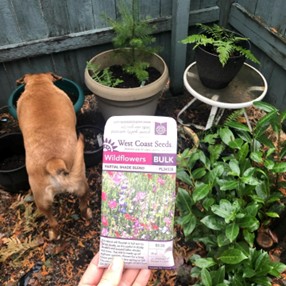
I scattered wildflower seeds from a West Coast Seeds packet directly onto the cold, brown earth contained within a five-litre pot on my apartment’s patio. Despite having a comfortable life, with a loving partner, a steady job, and an angel of a dog, I no longer wanted to be alive. I didn’t want to kill myself, per se, but the thought of not existing anymore was a great temptation. These thoughts came every winter as the days got shorter and colder, and life seemed to shrink in on itself.
Native wildflower seeds require cold stratification to break their dormancy. In nature, a plant goes to seed, and those seeds fall to the ground and are blanketed by fallen foliage, then snow. Finally, the warm Spring sun reaches the dirt, and the seed begins to germinate, grow roots, and sprout through the soil (1). For this reason, at-home gardeners scatter the seeds that require this treatment in the Fall for a beautiful field of blooms the following summer.
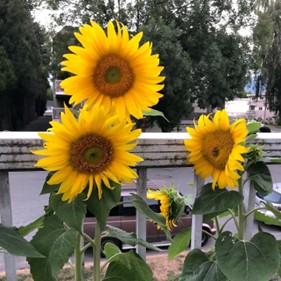 I wished these tiny seeds good luck as they fell from between my fingers and promised to see them again in their next iteration. I knew these seeds had a tenacious will to live, and I would too, once my brain could produce enough serotonin again (2). And sure enough, survive they did, providing constant bursts of blooms to feed the native pollinators and bring joy to a lifeless patio.
By no means do I want to discourage the intake of pharmaceutical treatments for mental health disorders, like depression and seasonal affective disorder. But I do want to highlight more holistic interventions that target non-clinical dimensions of well-being as an alternative to antidepressants that can be costly and have a diverse array of side effects. Countless studies cite positive correlations between gardening and improved mental health, particularly regarding marginalized populations, such as resettled refugees and those with mental illnesses (3; 4; 5; 6).
Once the first season of seeds was successful, I expanded the garden into the apartment’s clandestine backyard, which wasn’t included in any tenant’s lease and was being used as a large litterbox for the neighbourhood cat population. The landlords covered the ground with a thick, black tarp and covered that with a layer of gravel. Life was not permitted to grow there, lest it bring decay and disease to their investment property. I decided to ask for forgiveness, not permission, when filling the backyard with pots of soil.
Besides supporting one’s physical and mental health, gardens bear ecosystem, economic, and social impacts. Ecologically, these gardens moderate the microclimate around the building and provide food and a biodiverse habitat for native species (7). Gardens are a traditional means of increasing food security and growing medicine (8). Social cohesion is increased in allotment garden settings (9). In a time marked by pressured supply chains, an ever-increasing cost of living, and increasingly fragmented social connections, gardens present a holistic solution.
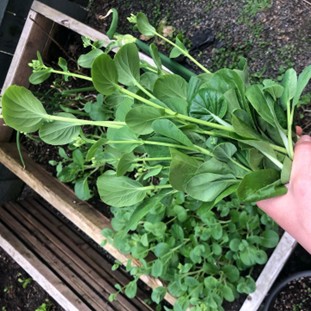
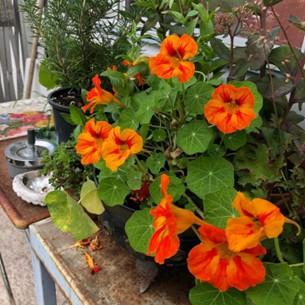
Dozens of pots contained edibles such as lettuce, radishes, beets, carrots, spinach, raspberries, pumpkins, kale, potatoes, and peppers; herbs such as lemon balm, mint, sage, oregano, rosemary, and lavender; and perennial native plants like douglas aster, goldenrod, goat’s beard, stinging nettle, ostrich ferns, yarrow, vine maples, cedars, and douglas firs. The garden created beauty and food for all six units of our apartment building. I learned how to compost, propagate perennials, and save seeds. The garden welcomed dragonflies, hummingbirds, and bees. It became my place of refuge and gave me a sense of hope and purpose that I once lacked.
In whatever settings gardens reside, be it hospitals, long-term care homes, schools, incarceration centres, or low-income housing units, these ecosystems will contribute to community health, social inclusion, and ecological regeneration (10). You don’t need a backyard, a patio, or a bed at a community garden to start. While an outdoor space is preferable, an empty yogurt pot of dirt on a windowsill will suffice. As you tend to the life of a seed, from germination to fruition to decomposition, I hope it revitalizes your own will to live as much as it did mine.
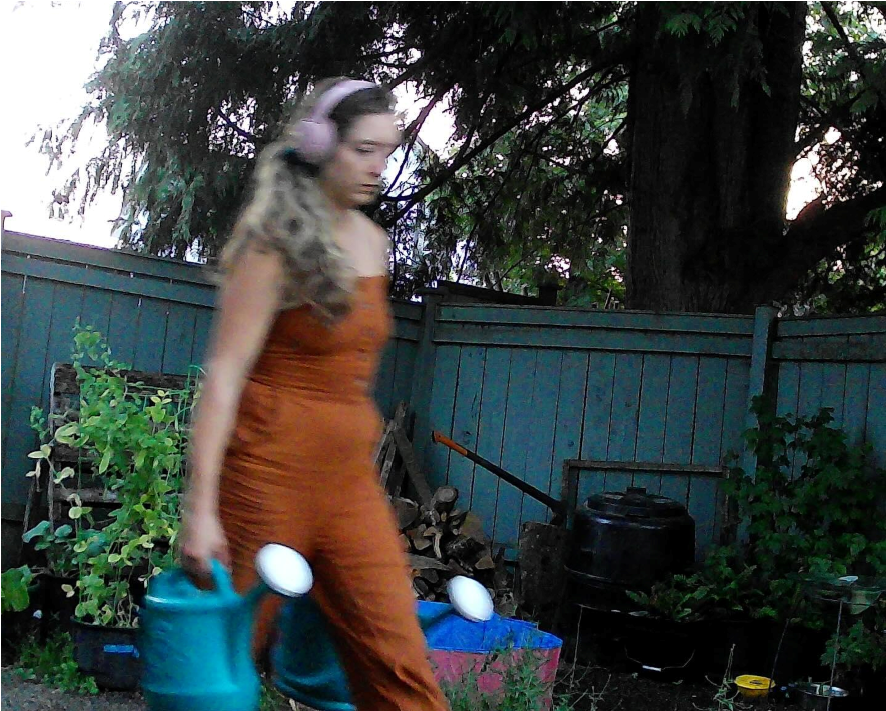
About the author: Andrea is a settler and a descendant of mixed European and Mennonite heritage, currently residing on traditional and unceded Stó:lō territory. She is currently completing her Master of Arts in Community Development at the University of Victoria. In her free time, she likes to putter in her garden, wander through the woods, and cook delicious vats of soup.
References:
1. Sandra, A. (2018, January 2). Growing native plants from seed : Cold stratification. OFNC.https://ofnc.ca/fletcher-wildlife-garden/growing-native-plants-from-seed-cold-stratif ication
2. U.S. Department of Health and Human Services. (n.d.). Seasonal affective disorder. National Institute of Mental Health. https://www.nimh.nih.gov/health/publications/seasonal-affective-disorder
3. Wang, F., & Boros, S. (2025). Effect of gardening activities on domains of health: A systematic review and meta-analysis. BMC Public Health, 25(1). https://doi.org/10.1186/s12889-025-22263-9
4. Ainamani, H. E., Gumisiriza, N., Bamwerinde, W. M., & Rukundo, G. Z. (2022). Gardening activity and its relationship to mental health: Understudied and untapped in low-and middle-income countries. Preventive Medicine Reports, 29, 101946. https://doi.org/10.1016/j.pmedr.2022.101946
5. Wood, C. J., Barton, J. L., & Wicks, C. L. (2022). The impact of therapeutic community gardening on the wellbeing, loneliness, and life satisfaction of individuals with mental illness. International Journal of Environmental Research and Public Health, 19(20), 13166. https://doi.org/10.3390/ijerph192013166
6. Whatley, E., Fortune, T., & Williams, A. E. (2015). Enabling occupational participation and social inclusion for people recovering from mental ill‐health through Community Gardening. Australian Occupational Therapy Journal, 62(6), 428–437. https://doi.org/10.1111/1440-1630.12240
7. Delahay, R. J., Sherman, D., Soyalan, B., & Gaston, K. J. (2023). Biodiversity in residential gardens: A review of the evidence base. Biodiversity and Conservation, 32(13), 4155–4179. https://doi.org/10.1007/s10531-023-02694-9
8. Minkoff-Zern, L.-A., Walia, B., Gangamma, R., & Zoodsma, A. (2023). Food sovereignty and displacement: Gardening for food, Mental Health, and community connection. The Journal of Peasant Studies, 51(2), 421–440. https://doi.org/10.1080/03066150.2023.2243438
9. Soga, M., Cox, D., Yamaura, Y., Gaston, K., Kurisu, K., & Hanaki, K. (2017). Health benefits of urban allotment gardening: Improved physical and psychological well-being and social integration. International Journal of Environmental Research and Public Health, 14(1), 71. https://doi.org/10.3390/ijerph14010071
10. Zywert, K. (2024). Sustainable communities for a healthy planet. University of Toronto Press.
Photo credits: Andrea Sadowski