

Selected climate- and education-related publications
Clow, K.M., N.H. Ogden, L.R. Lindsay, P. Michel, D.L. Pearl, and C.M. Jardine. “The Influence of Abiotic and Biotic Factors on the Invasion of Ixodes Scapularis in Ontario, Canada.” Ticks and Tick-Borne Diseases 8, no. 4 (2017): 554–63. https://doi.org/10.1016/j.ttbdis.2017.03.003.
Cole, D. C., M. W. Parkes, J. Saint-Charles, M. Gislason, K. McKellar and J. Webb "Evolution of Capacity Strengthening: insights from the Canadian Community of Practice in Ecosystem Approaches to Health." Transformative Dialogues: Teaching & Learning Journal 11(2). (2018).
Gislason, M.K., L. Galway, C. Buse, M. Parkes, and E. Rees. “Place-Based Climate Change Communication and Engagement in Canada’s Provincial North: Lessons Learned from Climate Champions.” Environmental Communication 15, no. 4 (2021): 530–45. https://doi.org/10.1080/17524032.2020.1869576.
Gislason, M.K., A.M. Kennedy, and S.M. Witham. “The Interplay between Social and Ecological Determinants of Mental Health for Children and Youth in the Climate Crisis.” International Journal of Environmental Research and Public Health 18, no. 9 (2021). https://doi.org/10.3390/ijerph18094573.
Morrison, K., M.J. Bunch, and L. Hallström. Public Health at the Watershed Scale. Vol. 17. Global Issues in Water Policy, 2017. https://doi.org/10.1007/978-3-319-42806-2_18.
Parkes, M., J. Saint-Charles, D. Cole, M. Gislason, E. Hicks, C. Le Bourdais, K. McKellar, M. St-Cyr Bouchard and CoPEH-Canada Team "Collaborative teaching and learning: Experiences from a short, intensive field course on ecosystems, health and society." Higher Education Research & Development. 1-16 (2016).
Poland, B., C. Buse, P. Antze, R. Haluza-DeLay, C. Ling, L. Newman, A.-A. Parent, et al. “The Emergence of the Transition Movement in Canada: Success and Impact through the Eyes of Initiative Leaders.” Local Environment 24, no. 3 (2019): 180–200. https://doi.org/10.1080/13549839.2018.1555579.
Smith, B.A., S. Meadows, R. Meyers, E.J. Parmley, and A. Fazil. “Seasonality and Zoonotic Foodborne Pathogens in Canada: Relationships between Climate and Campylobacter, E. Coli and Salmonella in Meat Products.” Epidemiology and Infection 147 (2019). https://doi.org/10.1017/S0950268819000797.
Vansteenkiste, J., Saint-Charles, J., FIllion, M., Lefrançois, M., Laberge, M., Webb, J., and Vaillancourt, C.. Critical evaluation of the inclusion of sex, gender, and integrated knowledge translation in a cohort from an intensive graduate level course on ecohealth. Interdisciplinary Science Reviews. (submitted)
Plénières de EcoHealth 2014
Production des vidéos: Cinbiose ; Caméra/Montage : Marty-Kanatakhatsus Meunier.
CONFÉRENCES ET SÉANCES PLÉNIÈRES de Ecohealth 2014
|
FRANÇOIS REEVESCentre hospitalier de l'Université de Montréal (CHUM), Canada Modératrice : Donna Mergler, CINBIOSE-UQAM, Canada |
MINNIE GREYNunavik Regional Board of Health and Social Services, Canada Modératrice : Donna Mergler, CINBIOSE-UQAM, Canada |
JIMMY SMITHInternational Livestock Research Institute, Kenya Modératrice : Dominique Charron, International Development Research Centre, Canada |
JEAN-REMY GUIMARÃESFederal University of Rio de Janeiro, Carlos Chagas Filho Institute of Biophysics, Brazil Modératrice : Céline Surette, Université de Moncton, Canada |




CONNEXIONS
EN LIEN AVEC LE GRAND THÈME DU COLLOQUE, CE PANEL a Mis L’ACCENT SUR LES LIENS ENTRE LES DIFFÉRENTES APPROCHES ET PRATIQUES.
Modératrice : Margot Parkes, University of Northern British Columbia, Canada
|
NIL BASUMcGill University, Canada |
HELEN MOEWAKA BARNESSHORE & Whariki Research Centre, Massey University, New Zeeland |
JIANCHU XUKunming Institute of Botany, Chinese Academy of Sciences, China |
|


SUR LE TERRAIN
UN PANEL CONSACRÉ AUX ORGANISATIONS ET GROUPES QUI METTENT EN PRATIQUE L’APPROCHE ÉCOSANTÉ DANS LEURS ACTIONS ET LEURS INTERVENTIONS.
Modératrice : Jena Webb, Centre de recherche interdisciplinaire sur le bien-être, la santé, la société et l'environnement (CINBIOSE), Université du Québec À Montréal (UQAM), Canada
|
MARY ANN COLEMANNew Brunswick Environmental Network, Canada |
ERNESTO RÁEZ LUNAMinistry of the Environment, Peru |
SUSILOWATI TANACenter for Health Policy and Social Change, Indonesia |
CHERYL GLADUConcordia University, CanadaVidéo |



ENVIRONNEMENTS URBAINS
CE PANEL PORTait SUR LES ENJEUX DE CE SUJET D’ACTUALITÉ.
Modérateur : Ugo Lachapelle, Université du Québec à Montréal (UQAM), Canada
|
GUÉLADIO CISSÉSwiss Tropical and Public Health Institute, Switzerland |
HOWARD FRUMKINUniversity of Washington School of Public Health, United States of America |
LISE GAUVINCentre de recherche du Centre Hospitalier de l’Université de Montréal (CRCHUM), Canada |
|



RELÈVE
CE PANEL ABORDait LES SUCCÈS ET PRÉOCCUPATIONS DE LA « NOUVELLE GÉNÉRATION EN ÉCOSANTÉ ».
Moderator : Esther Tong, Dalla Lana School of Public Health, University of Toronto, Canada
|
MÉLANIE LEMIREAxe santé des populations et pratiques optimales en santé, Centre de recherche du CHU de Québec, Université Laval, Canada |
LEANDRA FATORELLI
|
KARIM SAMOURAUniversité Aube Nouvelle, Burkina Faso |
TUYET-HANH TRAN THIHanoi School of Public Health, Vietnam et School of Clinical Sciences, The Queensland University of Technology, Australia |




INSTITUTIONS INTERNATIONALES
CE PANEL SOULeVait LES QUESTIONS DU RÔLE ET DE L’INFLUENCE DES GROUPES ET DES INSTITUTIONS INTERNATIONAUX ŒUVRANT SUR DES THÉMATIQUES PERTINENTES À L’ÉCOSANTÉ.
Modératrice : Erica Phipps, Canadian Partnership for Children's Health and Environment, Canada
|
RUTH CROMIEWildlife Health, Wildfowl and Wetlands Trust, United Kingdom |
JONATHAN EPSTEINEcohealth Alliance, United States of America |
HEIN MALLEEInsitute for Human and Nature Kyoto, Japan |
ANA RIVIERE-CINNAMONDPan American Health Organization, World Health Organization, Peru |



COMMUNIQUER LA COMPLEXITÉ
CE PANEL S’INTERROGait SUR LES MODES ET MANIÈRES DE COMMUNIQUER QUI PERMETTENT DE RENDRE COMPTE DE LA COMPLEXITÉ.
Modératrice : Johanne Saint-Charles, Centre de recherche interdisciplinaire sur le bien-être, la santé, la société et l'environnement (CINBIOSE), Université du Québec À Montréal (UQAM), Canada
|
PURVI MEHTA-BHATTInternational Livestock Institute, India |
MARK MEISNERInternational Environmental Communication Association, United States of America |
DAVID WALTNER-TOEWSVeterinarians without Borders and University of Guelph, Canada |
|



Evaluative research
The CoPEH-Canada team is conducting a research and evaluation program to examine the development of social networks and the educational and capacity building outcomes of the community of practice. CoPEH-Canada provides a platform to share and consolidate our collective experiences and foster further collaboration among Canadian researchers and practitioners as we continue to learn, innovate and develop knowledge and skills.
Publications on our teaching (2016-present)
Healthpunk: speculative methods for the future of planetary health Filip Maric, Bodhisattva Chattopadhyay, Jena Webb. (2026) The Lancet Planetary Health. https://doi.org/10.1016/j.lanplh.2026.101436.
This article, co-written by CoPEH-Canada's director of programmes and colleagues in Norway, discusses, among other examples, the use of speculative fiction and healthpunk in our yearly hybrid courses and webinar series since 2020.
Abstract: Summary
Challenges in planetary health necessitate the use of science fiction and speculative futurisms as tools for transformative change. A critical gap, however, is the absence of a framework for activating science fiction and speculative futurisms to address crises of imagination that obstruct planetary health and impede the advancement of corresponding transformation. We introduce healthpunk as an emerging science fiction and speculative futurisms framework that integrates speculative thinking with a focus on planetary health. A series of interventions involving students and professionals from diverse sectors was undertaken to identify key elements of such a framework. These interventions led to the co-creation of multiple anthologies on planetary health futures and indicated a positive reception of science fiction and speculative futurisms as a means of transforming planetary health among an expanding community of authors and readers. At the same time, the findings underscore the need for methodological guidance. We argue that a dedicated healthpunk training programme, grounded in a fully developed framework, could address existing challenges and enable the full potential of science fiction and speculative futurisms within planetary health practice.
Publications from our evaluative research (2008-2015)
This first period of research (2008-2012) highlighted a need for a new phase of consolidation and development of the community of practice to ensure long-term development and capacity in ecohealth in Canada and beyond. This included evaluation of our short course, contributing to its improvement, and exploration of the network of relationships in CoPEH-Canada. An example of the course evaluation questionnaire can be found here.
Strengthening collaborative capacity: experiences from a short, intensive field course on ecosystems, health and society. Parkes MW, Saint-Charles J, Cole DC, Gislason M, Hicks E, Le Bourdais C, et al. 2016. Higher Education Research & Development:1-16.
This quote-rich research article analyses three years (2008-2010) of student feedback on the CoPEH-Canada course. Findings highlight the importance of diversity (of background and language), relationships among students and the teaching team, and complexity in the teaching methods (reflecting the complexity of reality).
The second phase of research (2012-2015) has been linked with two projects. The first was a 3-year project entitled “Linking public health, ecosystems and equity through ecohealth training and capacity building,” funded by the Public Health Agency of Canada, which aimed to provide training to improve practitioner's and resercher's ability to identify, communicate and manage multiple social and ecological determinants of health related in an integrated way, specifically in relation to the core competencies of the Public Health Agency of Canada. The second project was conducted in collaboration with the Comunidad de Práctica sobre el Enfoque Ecosistémico en Salud Humana en América Latina y el Caribe (CoPEH LAC), and aimed to evaluate the development of the CoPEH-Canada network and its implications for research, education, practice and policy in ecosystem approaches to health.
Evolution of capacity strengthening: insights from the Canadian Community of Practice in Ecosystem Approaches to Health. Cole, D. C., M. W. Parkes, J. Saint-Charles, M. Gislason, K. McKellar and J. Webb (2018). Transformative Dialogues: Teaching & Learning Journal 11(2).
We describe a Community of Practice focused on capacity strengthening across higher education institutions in the complex field of ecosystem approaches to health. Incubated through the co-design of a Canada-wide intensive face-to-face course, the Community of Practice generated a teaching manual with flexible formats to extend our reach to other academic faculty and practitioners. We describe how the development of collaborations (process) has been dynamically linked with learning about ecosystem approaches to health (content domain) in ways congruent with the field’s complexity. We argue that cross-university, grounded Communities of Practice are particularly appropriate for transdisciplinary educational initiatives tackling the daunting socio-ecological problems, and the associated health and sustainability challenges, currently facing humanity.
Our research continues to focus on the interrelated themes of collaborative relationships and capacity building, and their contributions to the emerging field of ecohealth. For a selection of our member's climate- and education related research publications see here.
For more information about our Research and Evaluation program objectives, methods, activities and publications, please This email address is being protected from spambots. You need JavaScript enabled to view it.
International Field Building
International collaboration has always been part of the practice of CoPEH-Canada, reflecting the fact that most members of CoPEH-Canada also work in other countries. Members of CoPEH-Canada played a part in the creation of the first Community of Practice in Ecohealth in Latin America and the Caribbean, others have been involved in the development of the International Association for Ecology & Health, and Vets without Borders Canada.
CoPEH-Canada is also deeply indebted to the international community. As just one example, an international group of researchers and practitioners participated in a needs assessment which informed our teaching manual.
A few examples of our international collaborations are described below.
EcoHealth 2018
Sixteen separate presentations were given by CoPEH-Canada members at the EcoHealth 2018 conference. We held an informal 10-year anniversary social event gathering around 15 CoPEH-Canade members who had traveled to Cali.
Ekosanté
CoPEH-Canada has partnered with the Latin American and Caribbean Community of Practice on Ecosystem Approach to Human Health (CoPEH-LAC) on a project – called Ekosanté – to strengthen research, policy and practice at the intersection of health, ecosystems and society. Visit Ekosanté's Expertise mapping in Ecosystem Approaches to Health in Canada, Latin America and the Caribbean here.
EcoHealth 2014
EcoHealth 2014, the 5th Biennial Conference of the International Association for Ecology & Health, was co-hosted by CoPEH-Canada and Cinbiose. One of the goals of the EcoHealth 2014 Conference was to acknowledge the diversity within the field of ecohealth. The main theme for EcoHealth 2014 was Connections for health, ecosystems and society. These connections are critical for the development of the field of ecohealth as well as to an international, interdisciplinary and intersectoral conversation about environment (natural and social), health and equity.
The sub-themes of the conference were:
- Drivers of change to health, ecosystems and society: Integrating understanding from global to local scales
- Innovations in theory, methods and practice
- Moving between research and action: Mobilizing knowledge to benefit health, ecosystems, and society
The keynote and plenary presentations are available on our site.
To consult the abstract booklet click here.
For more information please visit the EcoHealthLive website.
ECOHEALTH AS A FIELD
In 2012, CoPEH-Canada hosted a pre-conference workshop at the EcoHealth 2012 conference held in Kunming, China. The goal of the workshop was to get a feel for where the international community saw the field of ecohealth heading. Our findings are described in a forum paper co-constructed with international colleagues and published in the journal EcoHealth in 2014.
Research and Practice in Canada
CoPEH-Canada identifies and develops strategies for long-term regional and institutional capacity to support ecosystem approaches to health, including complementary funding for diffusion, research, and exchange as well as training. The Community has enabled many initiatives, some of which are presented below.
Active RESEARCH GRANTS
EDGE grant - Curricular Reform for Public Health in the Anthropocene, CIHR Planning and Dissemination Grant |
| 2022-2023 |
|
CoPEH-Canada members Blake Poland (UoT) and Maya Gislason (SFU) submitted a successful application for a literature review on teaching at the intersection of health, environment and society. CoPEH-Canada will be contributing to the work. |
Former research grants
CoPEH-Canada connections with successful team grants CIHR competition in Intersectoral Prevention Research |
| 2017-2021 |
|
Two of the teams which made successful applications to CIHR’s competition for intersectoral prevention on health and environment involve direct collaborations with CoPEH-Canada.
To find out more about intersectoral prevention research at the CoPEH-Canada, please read our summary on the subject. |
CIHR Team Grant : Impact of Gender on Knowledge Translation Interventions |
| 2017-2021 |
| Members of the QAA node put in a successful application to the CIHR Team Grant : Impact of Gender on Knowledge Translation Interventions: Generating and passing on gender-conscious knowledge about equality, equity and occupational/environmental health. One of the case studies for a retrospective analysis will be in Environmental Health and the CoPEH-Canada course will serve as a reservoir for prospective studies. |
Webalogue series
Launched in April of 2014, this series of dynamic webalogues aims to highlight the variety of ways in which a range of practitioners, professionals, policy-makers and community members are grappling with topical, current and complex issues emerging at the nexus of population health, ecosystem and society. The 90-minute (or 2 hour) sessions are participatory and focused on learning and sharing. Issues cut across disciplines, sectors, jurisdictions, species and geographical boundaries.
Networking events
CoPEH-Canada works to increase connections between people interested in ecosystem approaches to health. We have helped form or rely on existing forums to spread the word.
- EDGE: Ecological determinants group on education
- Founding member of EcoHealth Ontario
- Webalogue series in Western node BC
- Ecohealth & Watersheds work (links to NESH)
- ‘Pilot training initiatives’ at Provincial Public Health Events
- Almost yearly Canadian Public Health Agency conference activities (pre/post conference meetings or networking breakfasts)
Ecohealth publications
Each of our members has a rich corpus of writings on, or using, ecosystem approaches to health. For example we recently carried out a review of work conducted by our core members on Intersectoral Prevention Research (to see the review click here). What is profiled below is the work that we have conducted together on the field of Ecosystem Approaches to Health in Canada. Please see each individual’s professional page or their Research Gate profiles for a complete list of their publications.
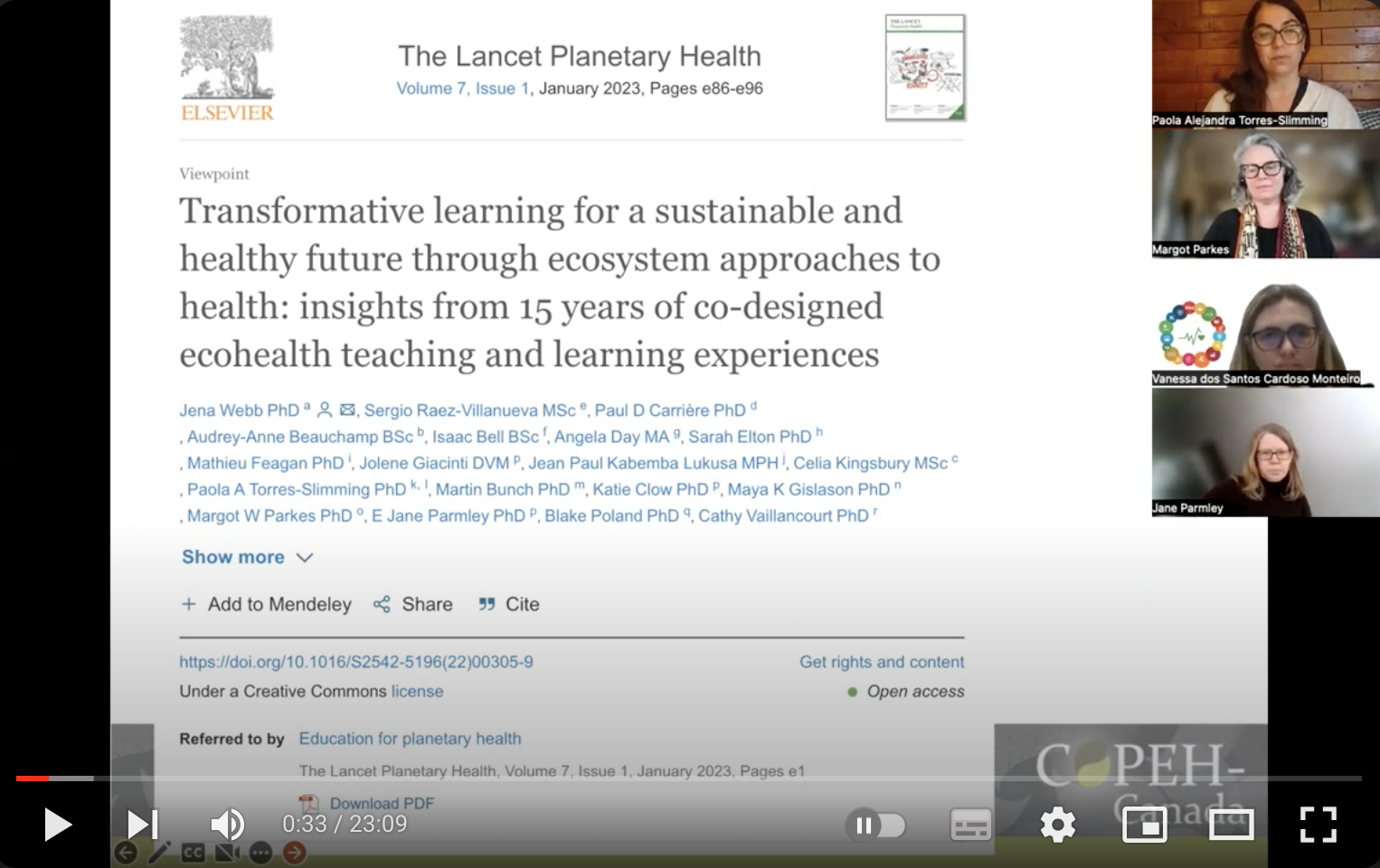
This paper presents insights from the work of the Canadian Community of Practice in Ecosystem Approaches to Health (CoPEH-Canada) and 15 years (2008–2022) of land-based, transdisciplinary, learner-centred, transformative learning and training. We have oriented our learning approaches to Head, Hands, and Heart, which symbolise cognitive, psychomotor, and affective learning, respectively. Psychomotor and affective learning are necessary to grapple with and enact far-reaching structural changes (eg, decolonisation) needed to rekindle healthier, reciprocal relationships with nature and each other. We acknowledge that these approaches have been long understood by Indigenous colleagues and communities. We have developed a suite of teaching techniques and resources through an iterative and evolving pedagogy based on participatory approaches and operating reciprocal, research-pedagogical cycles; integrated different approaches and ways of knowing into our pedagogy; and built a networked Community of Practice for continued learning. Planetary health has become a dominant framing for health-ecosystem interactions. This Viewpoint underscores the depth of existing scholarship, collaboration, and pedagogical expertise in ecohealth teaching and learning that can inform planetary health education approaches.
Application of an evaluation framework for extra-organizational communities of practice: assessment and refinement
McKeller, K.A, J. Saint-Charles, W. Berta, R Cockerill, D. C. Cole (2020). The Canadian Journal of Program Evaluation 35(2): 60-64.
The primary objective of this study was to assess the applicability of a multi-level, multiple value evaluation framework for extra-organizational CoPs. We conducted qualitative interviews with an extra-organizational CoP—the Canadian Community of Practice in Ecosystems Approaches to Health (CoPEH-Canada). Our findings showed that the evaluation framework was sufficiently comprehensive to capture values generated. Reflecting on our findings, we share challenges in its application and suggest revisions to the framework. We discuss limitations and strengths, evaluation research next steps, and the opportunities for future applications.
Evolution of capacity strengthening: insights from the Canadian Community of Practice in Ecosystem Approaches to Health
Cole, D. C., M. W. Parkes, J. Saint-Charles, M. Gislason, K. McKellar and J. Webb (2018). Transformative Dialogues: Teaching & Learning Journal 11(2).
We describe a Community of Practice focused on capacity strengthening across higher education institutions in the complex field of ecosystem approaches to health. Incubated through the co-design of a Canada-wide intensive face-to-face course, the Community of Practice generated a teaching manual with flexible formats to extend our reach to other academic faculty and practitioners. We describe how the development of collaborations (process) has been dynamically linked with learning about ecosystem approaches to health (content domain) in ways congruent with the field’s complexity. We argue that cross-university, grounded Communities of Practice are particularly appropriate for transdisciplinary educational initiatives tackling the daunting socio-ecological problems, and the associated health and sustainability challenges, currently facing humanity.
Strengthening collaborative capacity: experiences from a short, intensive field course on ecosystems, health and society
This quote-rich research article analyses three years (2008-2010) of student feedback on the CoPEH-Canada course. Findings highlight the importance of diversity (of background and language), relationships among students and the teaching team, and complexity in the teaching methods (reflecting the complexity of reality).
Connections for Health, Ecosystems and Society leading to Action and Change
This forum piece serves as an introduction to a special issue of the EcoHealth journal dedicated to the 5th Biennial Conference of the International Association for Ecology & Health, co-hosted by CoPEH-Canada and Cinbiose. It emphasizes the importance of relationships and connections in all the work we do to improve health, wellbeing and the environment.
Ecohealth as a field: Looking forward
The results of a pre-conference workshop hosted by CoPEH-Canada at the EcoHealth 2012 conference, Kunming, China are described in a forum paper co-constructed with international colleagues and published in the journal EcoHealth in 2014. The paper presents qualitative data from focus groups on where the international community sees the field of ecohealth heading.
Special issue of VertiGo
In conjunction with the EcoHealth 2014 conference, the Québec-Acadie-Atlantique node of CoPEH-Canada worked toward the launch of a special number of the journal, VertiGo, to promote the ecosystem approaches to health in the francophone world.
Teaching Manual
In 2012, a teaching manual in ecosystem approaches to health was published by CoPEH-Canada. The manual is comprised of a series of seven modules (Health, Ecosystem Approaches to Health, Complexity, Social Networks, Gender & Sex, Participation & Research and Transversal Activities (Building a Case Study)) intended to support people in designing, developing and teaching their own ecohealth courses. An abridged Spanish version is available and our teaching manual page features each module paired with multimedia.
Milestones in Canadian Population and Public Health research
Webb JC, Mergler D, Parkes MW et al. (2010) Tools for Thoughtful Action: The Role of Ecosystem Approaches to Health in Enhancing Public Health Canadian Journal of Public Health 101:439-441
In 2010, the Canadian Institutes for Health Research and Canadian Public Health Association recognised Ecosystem approaches to health as a ‘Milestone in Canadian Population and Public Health research,’ in recognition of major contributions to addressing challenges at the interface of ecosystems, society and health in Canada and beyond.
10-YEAR ANNIVERSARY
2018 was CoPEH-Canada’s 10-year anniversary. We had several activities planned, including a social event prior to the CPHA conference in Montreal in May and a social event at EcoHealth 2018 in Cali, Colombia in August.
"ECOHEALTH IN CANADA" – MEETING SERIES
This meeting series brought together colleagues from research, practice and policy involved in ecohealth research and practice to discuss future directions for the field and concrete collaborations.
Training and Capacity building
CoPEH-Canada designs training opportunities that bring people together from various backgrounds and multiple ways of knowing. Participants are trained to approach complex problems in ways that address the diverse considerations of ecosystem approaches to health - spanning environmental, social, and cultural influences on health for both humans and ecosystems.
Short courses
A central CoPEH-Canada activity is the collective design and delivery of ecosystem approaches to health summer schools. Since 2008, these courses have convened a diverse group of graduate students and practitioners from different fields for an intensive learning opportunity including case studies, fieldwork and interdisciplinary group work. Since 2012, our summer schools have offered both a career-development workshop, as well as course credit for students taking the full graduate level course.
Each May we offer a hybrid (on-line and on-site) course at multiple sites. In 2024, courses are being planned in Montreal, Guelph, Burnaby and Prince George. The webinar part of this offer can be followed without attending the onsite components for a certificate. More details can be found here.
TEACHING MANUAL
CoPEH-Canada has designed a teaching guide based on its learning in the design of the intensive course. This initiative has mobilized practitioners, faculty and graduate students across Canada and internationally. The team has developed a flexible modular structure intended for many uses such as short introductory training, two-week intensive courses, workshops, introductory one-day presentations, etc. This online manual continues to be developed with new modules. The manual has been fully translated into French, and an abridged version is available in Spanish. It is licensed under Creative Commons: Attribution, Non-Commercial, Share Alike and is available for download and dissemination.
CoPEH-Canada has a SSHRC Connection grant to produce new content on participation and equity.
Personalized Workshops
At CoPEH-Canada we design custom-made workshops and courses, for all levels, sectors and subjects touching on ecosystem approaches to health. We can work with groups interested in ecosystem approaches to health to tailor our teaching materials (see teaching manual for examples) to your needs.
Visit our collaboration page or contact us if you are interested in running a workshop or short course on or using ecosystem approaches to health.
For example, as a part of the project Linking public health, ecosystems and equity through ecohealth training and capacity building, funded by the Public Health Agency of Canada, each node designed and carried out a Career Development Workshop at local Public Health events. Each of these experiences has been drawn up into mini-modules for our teaching manual. These modules were based on the core competencies for Public Health in Canada.
The Québec-Acadie-Atlantique (QAA) Public Health and EcoHealth workshop was held in Québec City during the Journées annuelles de Santé Publique (JASP) in November 2014. The workshop addressed the complexity of working together: an environmental health illustration. The resulting module is titled, Working with partners for a healthy environment.
In March of 2014, a workshop at the Ontario Public Health Convention was hosted by EcoHealth Ontario, Forests Ontario, and the Friends of the Greenbelt Foundation. It brought together ninety-six professionals from a variety of sectors to discuss the links among health, well-being, and green space and to explore future opportunities for ecohealth-themed collaborations in this area.
The workshop was titled, “Realizing the Health Benefits of Green Spaces in a Changing World” and a report on the workshop can be found here. The resulting module for the CoPEH Teaching Manual is titled, “Fostering Intersectoral Collaboration.”
The Western Node hosted a pre-conference workshop at the Public Health Association of British Colombia's annual conference in December 2014 about the interface between intersectoral collaboration, ecohealth and core competencies in Public Health.
Areas of action
The Canadian Community of Practice in Ecosystem Approaches to Health (CoPEH-Canada) aims at supporting the development of ecosystem approaches to health through:
- Training and Capacity building
- Profiling and applying ecosystem approaches to health research and practice in Canada
- Contributing to field building in ecosystem approaches to health internationally
- Evaluating and researching networking and capacity building
CoPEH-Canada Course and Webinar Series

2026 Hybrid, multi-site Field course and webinar series on ecosystem approaches to health
May 7 to June 9, 2026
New Site at the university of calgary!!
(In collaboration with the CARES Network (Communautés rurales et éloignées en santé) and Canopy, the Canadian One Health Training Program on Emerging Zoonoses)
Discover innovative and dynamic approaches for better understanding the multiple factors that influence health – ecosystem approaches to health – with an experienced, pan-Canadian team. During this intensive course you will learn methods for carrying out research and interventions on issues at the nexus of health, ecosystems, equity and society. In a time of an unprecedented polycrisis, connections are more important than ever. Our course is designed to build relationships that can heal. Learn more about our land-based, transformative teaching style in our 2023 paper published in the Lancet Planetary Health.
This course is available to graduate students* from all disciplines and also to professionals interested in these themes. Students from all universities are welcome to register. It is possible to register for the full course at participating universities, with credits transferred, or for the webinars only**.
Objective. The overall objective of this course is to provide participants with a working knowledge of ecosystem approaches to health, such that they can integrate the principles into their own work, as necessary, and build relationships with land and among individuals with common interests in safeguarding a habitable future.
Theme: Each year, activities revolve around a theme, which, this year, is “Collectives of reciprocity: land and health.”
Content. 1) A stand-alone webinar series: This webinar series covers the main orientations of the Ecosystem approaches to health (complexity/systems thinking, transdisciplinarity, (ecosystem) sustainability, social and gender equity, participation, and knowledge to action)
2) The graduate-level courses include:
- The webinar series (see above)
- Discussions and workshops on webinar topics
- Group work on a land-based case study with field components
- Activities to help students integrate new knowledge into their own projects (for example a thesis or an intervention)
- Assignments, readings and “listenings” (e.g. podcasts), both required and suggested
- Land-Based Ways journaling
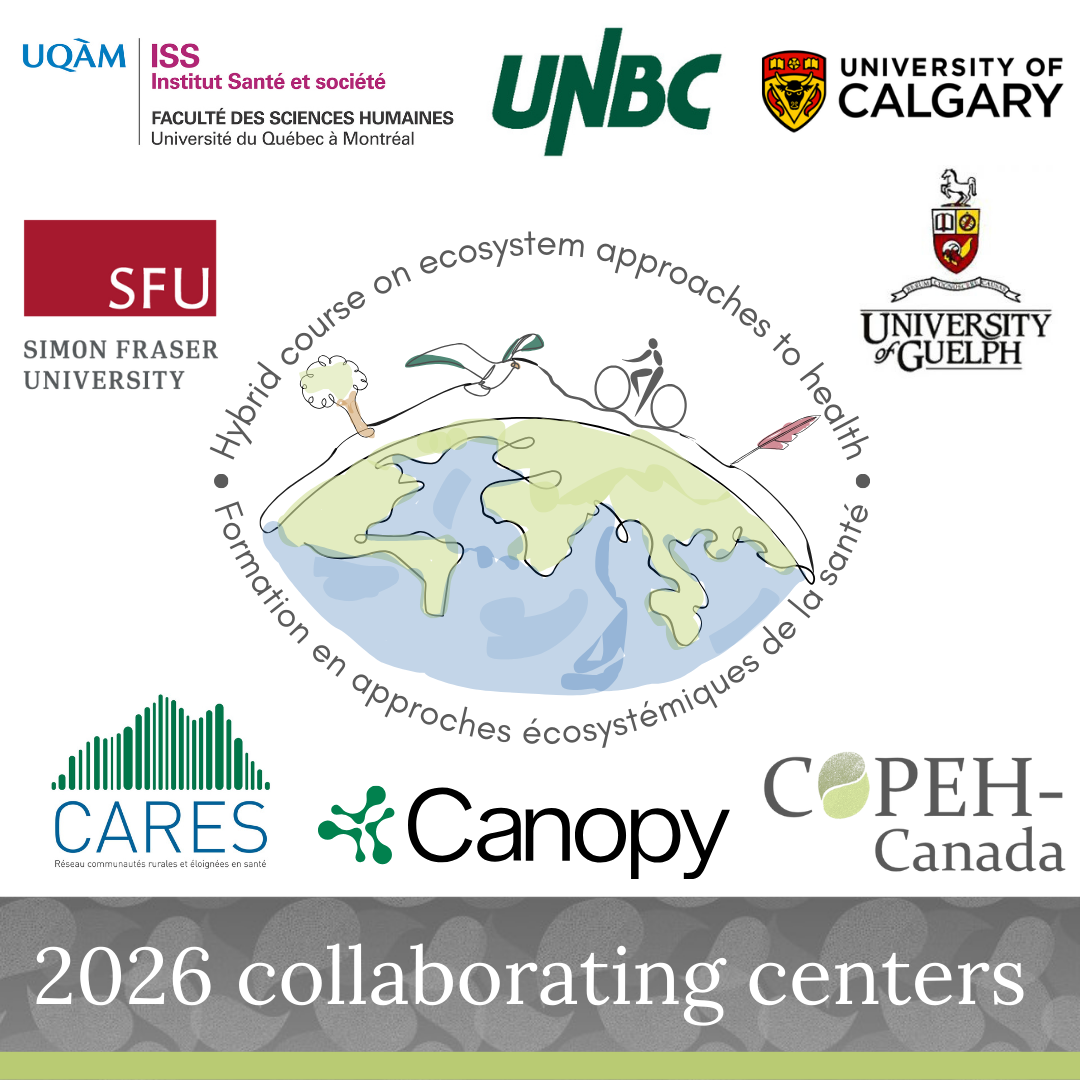
Format. There are two ways to participate: as a student in one of the full credit graduate courses held at five universities, the Université du Québec à Montréal (UQAM), the University of Guelph, the University of Calgary, Simon Fraser University (SFU) and the University of Northern British Columbia (UNBC), or as a participant in the 8-part webinar series. We offer continuing education credits and a certificate for participating in the webinar series.
Schedule. The webinars run on Tuesday and Thursday from 12:30 to 2:30 pm Eastern time from May 7th to June 9th, except the 26th and 28th of May. Each university has its own schedule for the remainder of the full course content, including land-based learning with field visits.
For more information or to rergister, contact us:
- For those interested in following the webinar series or for general information, please contact us at This email address is being protected from spambots. You need JavaScript enabled to view it.
- For those interested in the course at the University of Guelph, contact Jane Parmley at jparmley <at> uoguelph.ca
- For those interested in the course at the University of Calgary, contact Lindsay McLaren at This email address is being protected from spambots. You need JavaScript enabled to view it.
- For those interested in the course at SFU, contact Maya Gislasen at This email address is being protected from spambots. You need JavaScript enabled to view it.
- For those interested in the course at UNBC, contact Wii Esdes, Sandra Martin Harris at harriss <at> unbc.ca
- For those interested in the course in Montréal, Johanne Saint-Charles at This email address is being protected from spambots. You need JavaScript enabled to view it.
The courses running out of the participating universities are considered full credit courses with associated credits. The webinar series alone, at 16 hours in total, does not constitute a full, graduate-level course in and of itself. However, if you are interested in using the webinars, readings and cross-site activities as part of an independent/directed reading course, please This email address is being protected from spambots. You need JavaScript enabled to view it.. We provide a certificate and Continuing education credits for the webinar series.
People who have previously attended our course or webinar series and who would like to re-register are encouraged to contact us to discuss options.
*Upper-level undergraduate students are also admitted under certain conditions, depending on the programme.
** Fees apply for the webinar-only option. Click here for fees and This email address is being protected from spambots. You need JavaScript enabled to view it. if you have questions.
The tentative 2026 flow of webinars is as follows. The dates and times of webinars will not change, but the order of topics may change.
| Webinar | Topic | Lead |
|
May 7, 2026 |
Orientation to Hybrid Course/Webinar Series: Introduction & History of Ecosystem approaches to health Principles |
Wii Esdes, Sandra Martin Harris, Witsuwit’en Nation and UNBC; Lindsay McLaren, University of Calgary; Jena Webb, UQAM |
| May 12, 2026 |
Ecosystem Sustainability |
Lindsay McLaren and Melanie Kloetzel, University of Calgary |
| May 14, 2026 | Complexity & Systems Thinking |
Jane Parmley, UofGuelph; Tarra Penney, York University |
| May 19, 2026 |
Participation |
Maya Gislason, SFU |
| May 21, 2026 | Equity |
Mumbi Maina, Manager of Diversity, Equity and Inclusion, Provincial Health Services Authority, BC; Cody Thomas, Mohawk Nation and Two Row Innovations |
| June 2, 2026 | Transdisciplinarity and Knowledges |
Wii Esdes, Sandra Martin Harris, Witsuwit’en and UNBC; Margot Parkes, UNBC |
| June 4, 2026 | Knowledge Exchange and Communication | Johanne Saint-Charles, UQAM |
| June 9, 2026 | Synthesis - Collectives of reciprocity: land and health | Full team |
We would like to thank our collaborating centers:
Lancet planetary health paper
Penned by 19 co-authors, including 11 alumni of CoPEH-Canada's training, and published January 4th 2023 in the Lancet Planetary Health, Transformative learning for a sustainable and healthy future through ecosystem approaches to health: insights from 15 years of co-designed ecohealth teaching and learning experiences discusses CoPEH-Canada's pedagogical leanings. If you are interested in taking our hybrid course or webinar series, this is a great way to learn more! Also, you can listen to part of a webinar given on the paper and our teaching to learn more.
Course participant Blogs and short stories
Each year, the participants of CoPEH-Canada's hybrid course write a blog or a short story on a topic of their choice related to ecosystem approaches to health and share with the other participants. Then, everyone votes on their top three blogs and the three highest scoring blogs are published here. Along with the votes, participants have to provide a tweet for each blog they voted for, which we then use to publisize the blogs from our Bluesky account copeh-canada.bsky.social. You can read past year's blogs here.
EcoHealth 2014 Keynotes and Plenary panels
All videos produced by Cinbiose with filming and editing by Kanatakhatsus.
keynoteS
|
FRANÇOIS REEVESCentre hospitalier de l'Université de Montréal (CHUM), Canada Opening speech |
MINNIE GREYNunavik Regional Board of Health and Social Services, Canada Moderator: Donna Mergler, CINBIOSE-UQAM, Canada |
Jimmy SmithInternational Livestock Research Institute, Kenya Moderator: Dominique Charron, International Development Research Centre, Canada |
Jean-Remy GuimarãesFederal University of Rio de Janeiro, Carlos Chagas Filho Institute of Biophysics, Brazil Moderator: Céline Surette, Université de Moncton, Canada |
Connections
Linking with the overarching theme of the conference, this panel will touch on different approaches and practices in ecohealth.
Moderator: Margot Parkes, University of Northern British Columbia, Canada
|
Nil BasuMcGill University, Canada |
Helen Moewaka BarnesSHORE & Whariki Research Centre, Massey University, New Zeeland |
Jianchu XuKunming Institute of Botany, Chinese Academy of Sciences, China |
|
In the field
Guest speakers will be invited to speak of their experiences in the field in this panel.
Moderator: Jena Webb, Center for Interdisciplinary Research on Well-Being, Health, Society and Environment (CINBIOSE), Université du Québec À Montréal (UQAM), Canada
|
Mary Ann ColemanNew Brunswick Environmental Network, Canada |
Ernesto Ráez LunaMinistry of the Environment, Peru |
Susilowati TanaCenter for Health Policy and Social Change, Indonesia |
Cheryl GladuConcordia University, CanadaVideo |
Urban environments
This panel will highlight ongoing work on this topical issue.
Moderator: Ugo Lachapelle, Université du Québec à Montréal (UQAM), Canada
|
Guéladio CisséSwiss Tropical and Public Health Institute, Switzerland |
Howard FrumkinUniversity of Washington School of Public Health, United States of America |
Lise GauvinCentre de recherche du Centre Hospitalier de l’Université de Montréal (CRCHUM), Canada |
|
Emerging scholars and practitioners
This panel is given over to young researchers who will discuss their vision and preoccupations with the field of ecohealth.
Moderator: Esther Tong, Dalla Lana School of Public Health, University of Toronto, Canada
|
Mélanie LemireAxe santé des populations et pratiques optimales en santé, Centre de recherche du CHU de Québec, Université Laval, Canada |
Leandra Fatorelli
|
Karim SamouraUniversité Aube Nouvelle, Burkina Faso |
Tuyet-Hanh Tran ThiHanoi School of Public Health, Vietnam et School of Clinical Sciences, The Queensland University of Technology, Australia |
The role of global institutions and NGOs
This panel will bring to light the role and the influence of international groups and institutions working on issues linked to ecohealth.
Moderator: Erica Phipps, Canadian Partnership for Children's Health and Environment, Canada
|
Ruth CromieWildlife Health, Wildfowl and Wetlands Trust, United Kingdom |
Jonathan EpsteinEcohealth Alliance, United States of America |
Hein MalleeInsitute for Human and Nature Kyoto, Japan |
Ana Riviere-CinnamondPan American Health Organization, World Health Organization, Peru |
Communicating complexity
This panel will cover ways of communicating which do justice to the complexity of the issues faced in ecohealth.
Moderator: Johanne Saint-Charles, Center for Interdisciplinary Research on Well-Being, Health, Society and Environment (CINBIOSE), Université du Québec À Montréal (UQAM), Canada
|
Purvi Mehta-BhattInternational Livestock Institute, India |
Mark MeisnerInternational Environmental Communication Association, United States of America |
David Waltner-ToewsVeterinarians without Borders and University of Guelph, Canada |
|