

News Archive
CoPEH-Canada Course and Webinar Series
- Details
- Published on Monday, 23 January 2017 06:58
2027 Hybrid, multi-site Field course and webinar series on ecosystem approaches to health
May 13 to June 15, 2027
(In collaboration with the CARES Network (Communautés rurales et éloignées en santé) and Canopy, the Canadian One Health Training Program on Emerging Zoonoses)
Discover innovative and dynamic approaches for better understanding the multiple factors that influence health – ecosystem approaches to health – with an experienced, pan-Canadian team. During this intensive course you will learn methods for carrying out research and interventions on issues at the nexus of health, ecosystems, equity and society. In a time of an unprecedented polycrisis, connections are more important than ever. Our course is designed to build relationships that promote resilience and well being.
Learn more about our land-based, transformative teaching style in our 2023 paper published in the Lancet Planetary Health.
This course is available to students and professionals from all disciplines. Students from all universities are welcome to register. It is possible to register for the full course at participating universities, with credits transferred, or for the webinars only* (continuing education credits are offered).
Objective. Provide participants with working knowledge of ecosystem approaches to health, such that they can integrate the principles into their own work and build relationships with land and among individuals with a common interest in safeguarding a habitable future.
Theme. Reciprocal Relations: Nourishing Ecosystems, Communities and Health.
Content. 1) A stand-alone, 8-part webinar series covering the main orientations of the Ecosystem approaches to health (complexity/systems thinking, transdisciplinarity, (ecosystem) sustainability, social and gender equity, participation, and knowledge to action)
2) Graduate-level courses including:
- The webinar series (see above)
- Discussions and workshops on webinar topics
- Group work on a land-based case study with field components
- Activities to help students integrate new knowledge into their own projects (for example a thesis or an intervention)
- Assignments, readings and “listenings” (e.g. podcasts), both required and suggested
- Land-Based Ways Journaling
Format. There are two ways to participate:
- as a student in one of the full-credit courses held at five universities (the Université du Québec à Montréal (UQAM), the University of Guelph, the University of Calgary, Simon Fraser University (SFU) and the University of Northern British Columbia (UNBC)), or
- as a participant in the 8-part webinar series. We offer continuing education credits and a certificate for participating in the webinar series. Fees apply*.
Schedule. The webinars run on Tuesdays and Thursdays from 12:30 to 2:30 pm Eastern time / 10:30 to 12:30 Mountain time / 9:30 to 11:30 Pacific time from May 13th to June 15th, except June 1st and 3rd. Each university has its own schedule for the remainder of the full course content, including land-based learning with field visits (moslty held during the week of May 31st).
For more information or to rergister, contact us:
- For those interested in following the webinar series or for general information, please contact us at This email address is being protected from spambots. You need JavaScript enabled to view it.
- For those interested in the course at the University of Guelph, contact Jane Parmley at jparmley <at> uoguelph.ca
- For those interested in the course at the University of Calgary, contact Lindsay McLaren at This email address is being protected from spambots. You need JavaScript enabled to view it.
- For those interested in the course at SFU, contact Maya Gislasen at This email address is being protected from spambots. You need JavaScript enabled to view it.
- For those interested in the course at UNBC, contact Wii Esdes, Sandra Martin Harris at harriss <at> unbc.ca
- For those interested in the course in Montréal, contact Johanne Saint-Charles at This email address is being protected from spambots. You need JavaScript enabled to view it.
The courses running out of the participating universities are considered full credit courses with associated credits. The webinar series alone, at 16 hours in total, does not constitute a full, graduate-level course in and of itself. However, if you are interested in using the webinars, readings and cross-site activities as part of an independent/directed reading course, please This email address is being protected from spambots. You need JavaScript enabled to view it.. We provide a certificate and Continuing education credits for the webinar series.
People who have previously attended our course or webinar series and who would like to re-register are encouraged to contact us to discuss options.
* Fees apply for the webinar-only option. Click here for fees and This email address is being protected from spambots. You need JavaScript enabled to view it. if you have questions.
The 2026 flow of webinars was as follows. We provide this to give an idea of the content. The 2027 schedule will be posted in the new year.
| Webinar | Topic | Lead |
|
May 7, 2026 |
Orientation to Hybrid Course/Webinar Series: Introduction & History of Ecosystem approaches to health Principles |
Wii Esdes, Sandra Martin Harris, Witsuwit’en Nation and UNBC; Lindsay McLaren, University of Calgary; Jena Webb, UQAM |
| May 12, 2026 |
Ecosystem Sustainability |
Lindsay McLaren and Melanie Kloetzel, University of Calgary |
| May 14, 2026 | Complexity & Systems Thinking |
Jane Parmley, UofGuelph; Tarra Penney, York University |
| May 19, 2026 |
Participation |
Maya Gislason, SFU |
| May 21, 2026 | Equity |
Mumbi Maina, Manager of Diversity, Equity and Inclusion, Provincial Health Services Authority, BC; Cody Thomas, Mohawk Nation and Two Row Innovations |
| June 2, 2026 | Transdisciplinarity and Knowledges |
Wii Esdes, Sandra Martin Harris, Witsuwit’en and UNBC; Margot Parkes, UNBC |
| June 4, 2026 | Knowledge Exchange and Communication | Johanne Saint-Charles, UQAM, Valerie Berseth |
| June 9, 2026 | Synthesis - Collectives of reciprocity: land and health | Full team |
We would like to thank our collaborating centers:
Lancet planetary health paper
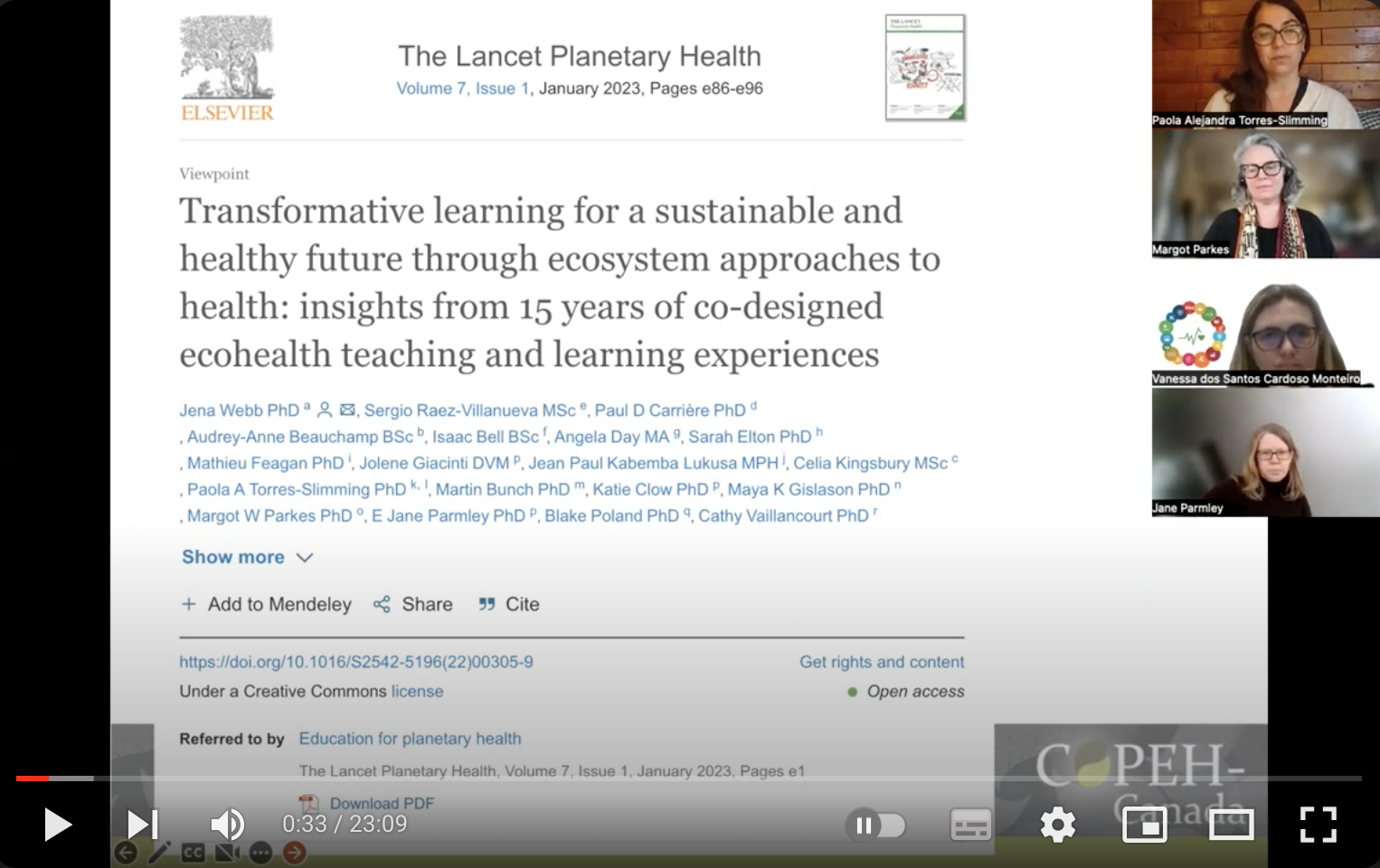
Penned by 19 co-authors, including 11 alumni of CoPEH-Canada's training, and published January 4th 2023 in the Lancet Planetary Health, Transformative learning for a sustainable and healthy future through ecosystem approaches to health: insights from 15 years of co-designed ecohealth teaching and learning experiences discusses CoPEH-Canada's pedagogical leanings. If you are interested in taking our hybrid course or webinar series, this is a great way to learn more! Also, you can listen to part of a webinar given on the paper and our teaching to learn more.
Course participant Blogs and short stories
Each year, the participants of CoPEH-Canada's hybrid course write a blog or a short story on a topic of their choice related to ecosystem approaches to health and share with the other participants. Then, everyone votes on their top three blogs and the three highest scoring blogs are published here. Along with the votes, participants have to provide a tweet for each blog they voted for, which we then use to publisize the blogs from our Bluesky account copeh-canada.bsky.social. You can read past year's blogs here.